Tuesday, November 17, 2015

Andalucia, Parte Dos: Cordoba

Ready to be picked
Our plan to spend two nights in each city for the first week of our trip to Spain and Portugal worked out rather well: It gave us an idea of the character of the cities that we visited while allowing us unhurried transfers during which we could add to our sightseeing. Thus driving for 150 or 200 kilometers was not a chore but rather a welcome element of this trip.
Endless olive orchards outside of Granada
We left Granada behind and drove north-west on a fairly empty highway, the N432. The road was winding through sheer endless olive groves, with most of the soil bare between the trees, making Sabine lament the lack of balanced vegetation in lieu of such a mono-culture. We stopped by the wayside and saw that the olives were dark and ready to be picked; I tasted one off the tree and it was extremely tart and inedible. They definitely need to be cured or pressed for oil.
The cathedral at La Mota
Replica of a medieval trebuchet
La Forteleza de la Mota towers over Alcala la Real
About 50 kilometers from Granada we came across La Fortaleza de la Mota, an old fortress just outside of Alcala la Real that goes back all the way to Roman times (and then some). This part of the world was in an almost constant state of upheaval, with the Romans being replaced by the Visigoths who had to make way for the Moorish rulers who then were replaced by the Castilians. We had the entire fortress pretty much to ourselves as there are hardly any tourists at this time of the year—it doesn't get much quieter than this.
Entrance to the family owned Nunez de Prado oil mill
Only the best extra virgen olive oil—less than 2% acidity
The view from La Mota is amazing. One can see the Sierra Nevada toward the southwest, looming over Granada, while all the other hills with their olive trees surround the fortress in ever-receding lines. From up here one can see something like about a dozen watchtowers that the rulers of La Mota had built to get advance warning of advancing enemies. Quite a system.
Large stones are used to grind the olives into paste
The paste is slowly moved through these tubes so that oil starts to leak out
Hydraulic presses remove even more oil
Nothing digital here: All bottles are hand labeled
A few miles down the road, in Baena, we went to a small, family-owned oil mill where one of the two brothers who run the show gave us a bit of a tour and some insight into the operations. The octogenarian reminded both of us of the old butler in the "Ninetieth Birthday," a cult must-see skit that German TV replays umpteen times every New Years. If you have seen it, you can picture Fernando Nunez de Prado.
Califa, our one and only brewpub of the trip (in Cordoba)
Quite a selection, and the beer was good
Reaching our hotel in Cordoba once again involved negotiating extremely tight streets of a city that was not built for modern traffic. But we didn't lose any rear view mirors or added any scratches longer than 5 centimeters, so that was good. Our hotel did not have the same view as the one in Granada, but then, we were quite happy with our baroque-appointed room in the Hospedaje El Churrasco, our home for the next two nights.
From the bell tower of the Mezquita one can see what was originally mosque and how the church was built into its middle
The Mezquita's Christian bell tower, formerly the minaret
Moorish as it comes
Two religions, two epochs, one amazing structure
Just as Granada has the Alhambra so does Cordoba have its own major draw, La Mezquita, the Roman temple turned mosque turned cathedral that is in the center of the old town. But Cordoba has so much more to see: There's the beautiful Roman bridge across the Guadalquivir, the Palace of the Christian Kings (Alcazar), the royal stables, and of course the confusing maze of tiny streets that make navigation a real challenge. Our hotel was right in the Juderia, the old Jewish part of Old Town, and thus we were smack-dab in the middle of it all. The mixture of Moorish and Christian elements in architecture is a constant reminder of the turbulent history of these cities, and it makes for an unending stream of impressions and views.
Brothers in beards and mustaches
Where is PETA? At the royal stables, witnessing training sessions for the evening performance
Amazing maze
Just like in Granada, we climbed many steps to get on top of turrets and towers. The view of a city from up on top adds a completely new component to sightseeing and one gets a much better appreciation of the layout and the floorplans of palaces and gardens as well as the city itself. Now, if we could only get Sabine to understand that just because one stands under a big bell doesn't mean that one has to try to ring it! I thought we were going to get kicked out of town....
Don't ring the bell, Quasimodo!
Since we were staying in hotels (average cost about $75) we went out to eat in restaurants every night, either for a complete meal of simply tapas and drinks. Breakfast was included in all hotels (very nice breakfasts, I should add), and during the day we didn't feel hungry. The only drawback to traveling during this time of the year is that it gets dark so early (around 6 p.m.), but the cities take on a different character at night with all those intimate lights that are so characteristic for a European old town.
Some of the world's greatest gardens, some of the world's worst gardeners
My overall impression of Cordoba: With the Mezquita right in the middle of the old town area Cordoba doesn't have the separation that Granada has with the Alhambra on one ridge and the Albayzin on the opposite hill. The lack of elevation makes for a less scenic city, yet the narrow streets are quite charming. Still, Cordoba appeared to me less medieval than Granada and maybe a bit more North African in its character—I base that on my faint memories of Tunis and similar cities 40 years ago. I can't say that either Cordoba or Granada had the upper hand for me in attractiveness—they're quite different and definitely both worth a trip.
Roman, Moorish, Castilian—Cordoba has it all, like the entire region
 Stay tuned for what awaited us in Sevilla.

Jürgen

Andalucia: Parte Un, Malaga y Granada


Not your average DoubleTree—overlooking the Mediterranean near Malaga
Last Sunday I arrived a few minutes after 5 p.m. in the Malaga airport, after the usual LBB-DFW-MAD hop. It was another one of these meet-Sabine-in-the-airport encounters: She had arrived coming from Munich just 20 minutes earlier. It has become so easy to plan such trips, yet as the events in Paris just a few days ago have shown us, we can't take anything for granted.
Costa del Sol
Sabine and I had planned this vacation for a month or two, making plane and car rental reservations and making sure that we had lined up hotels for the next two weeks. Actually, I was in charge of the hotels this time around, and looking back now I have to say that I hit them right. Our first one, the DoubleTree just outside of Malaga, was definitely an unusual one: Forget what you know about US-based DoubleTrees and rather think of a modernistic, artsy hotel overlooking the Mediterranean, with floating mirrors in the room and an infinity pool on the roof. Works of art were displayed in the caracol-shaped atrium (plus an MG from the '50s and a beautiful wooden skiff) and the corridor used shrill neon light to create a surreal effect. This was quite NOT Andalusian.
First glimpse of the Alhambra
Second glimpse over Happy Hour
Monday morning we took off for Granada, our first designated target. We took the auotopista along the Costa Del Sol and stopped over for a bit of beach-town walking in La Herradura, one of hundreds of small towns that cater to mainly German and British tourists during the summer but that at this time of the year are almost forgotten and have scaled back services and noise to a lovable level.
Granada's Old Town, the Albayzin, is scenic beyond belief
Flamenco is revered here
Typical house front in the Albayzin
From here the road turned inland and upward. This is not a great place to ride your bike, I'd think. I was reminded of the hinterland of the French Cote D'Azur where mountains loom right behind the coastal strip. Same here. Our little VW Polo zipped up the slopes—what a fine motorway. The land became very arid very rapidly, and I was reminded of the western US. We saw a few modern windmills on some of the ridges, but otherwise it was mostly rocky fields and not much civilization outside of smallish villages that were whitewashed and seemed forgotten by those traversing the countryside on the four-lane highway. BTW, this fine road was not a toll road as it surely would have been in Italy or Austria.
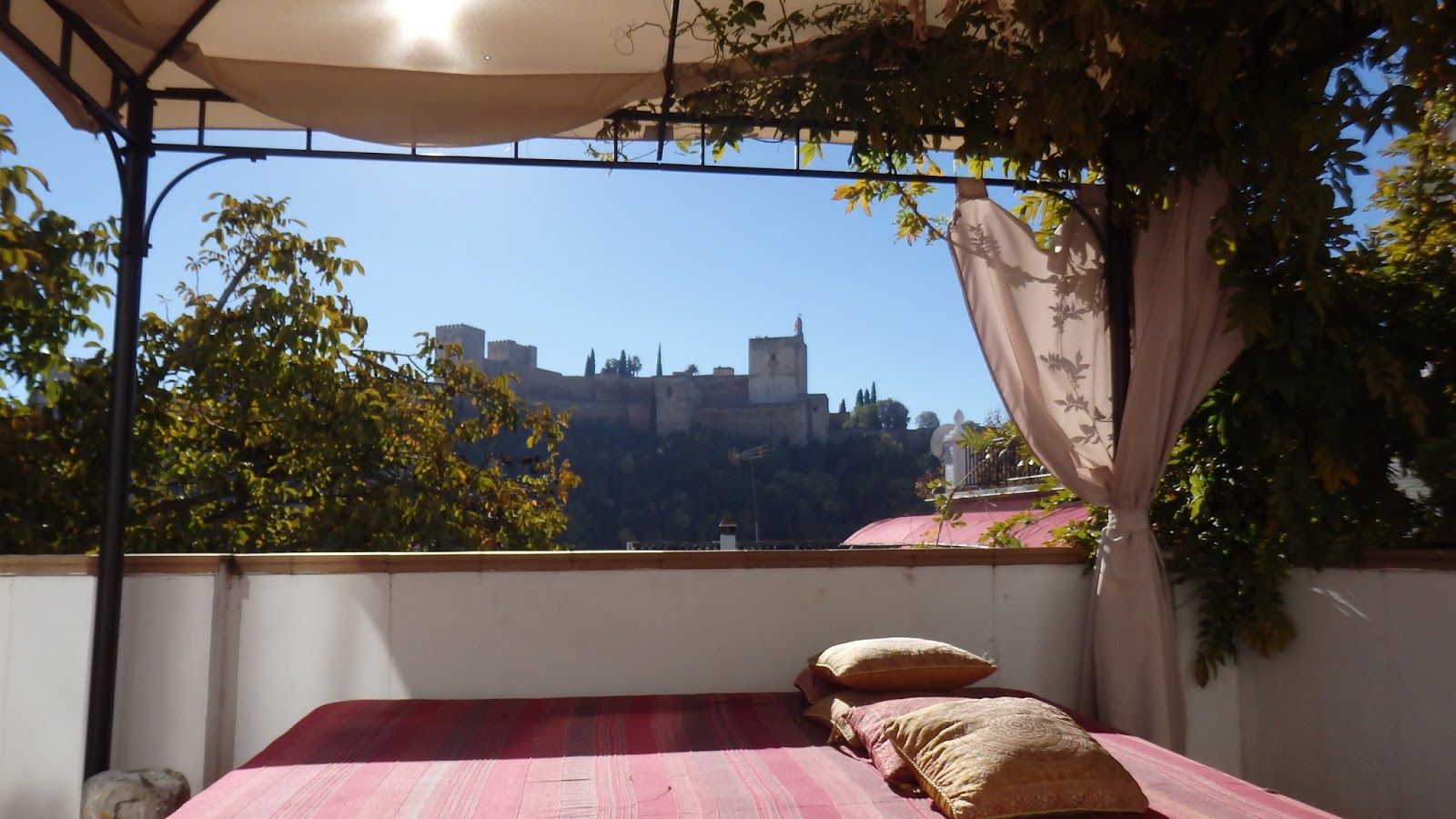
The view from our terrace at the Casa Bombo
By mid-afternoon (late start, beach walking in La Herredura) we topped the sierra and looked upon the vast, funnel-like plain over which Granada holds vigil. Forget the deep blue skies that had looked so refeshing—here we were greeted by smog, less from cars than untold fires lit to burn trash and dead vegetation. No, this was not so savory looking and really quite a let-down.

Granada as seen from the Alhambra
We knew that our hotel was located in the Albayzin, the old city center on the other side of the Alhambra, a medieval-and-earlier maze of tiny and even tinier roads that are OK for a pedestrian or a donkey, but not a car. Somehow we managed to find a parking spotlet (fold in the mirrors; park in a way that the driver has to climb out the passenger door; hope for the best) and walked the final 500 meters to our hotel, Casa Bombo. We opened the door to our room—and there was the Alhambra on the opposing ridge. Oh man, what a place!
 
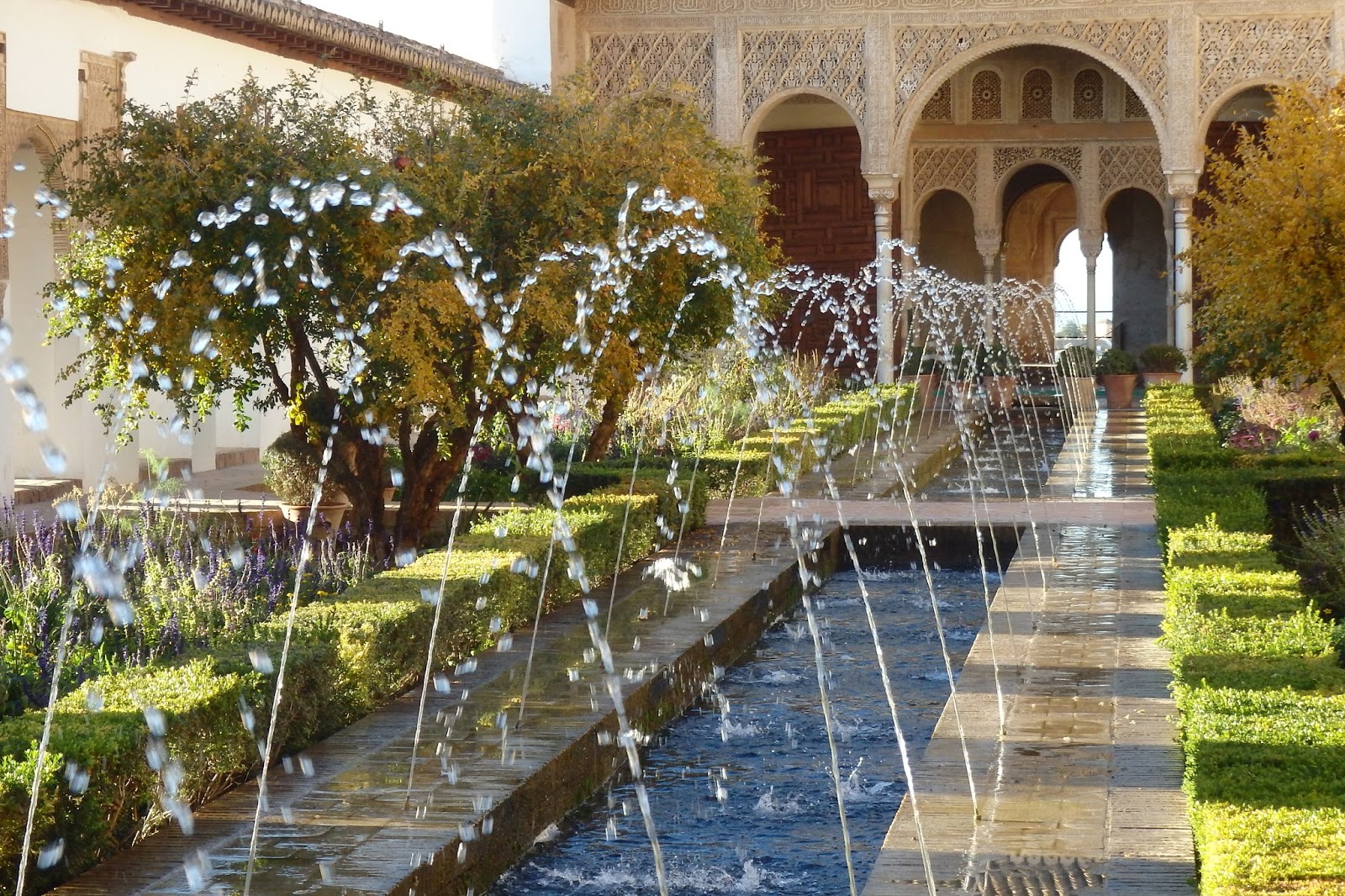
We stayed for two nights in Granada. Number one: Do yourself a favor and stay in the Casa Bombo if you go there! Number two: Don't worry about getting lost. If in doubt, just go downhill and eventually you're going to figure out where you are. And numero tres: The Alhambra is really as fabulous as you may have heard. I was reminded in so many ways of the Sultan's Palace in Istanbul as well as the Taj Mahal in India, iconic places in their own right. The architecture is stunning, but what really is going to get you are the gardens and all those fountains and water works. Visiting a place like this with a landscape architect such as Sabine is, of course, deadly, but even without her I would have started to develop ideas about how to incorporate water features into my backyard to make it livable. I'll let some of the pics speak for themselves.
 
Speaking of photos: It is so difficult—really, impossible—to visit a place like this without being totally overwhelmed by the urge to snap pic after pic. At least we don't carry selfie-sticks.... To imagine the Alhambra at the height of the tourism season is sheer insanity. We had been able to buy (online) tickets with only a week to spare (and we were lucky!), but in the summer better allow a few months' advance notice to score tickets as access to this World Heritage Site is tightly controlled and if you don't have tickets, well, you're simply SOf''nL.
Happy hour overlooking the Alhambra, about 24 hours after touching down in Andalusia. Falling asleep with a view of the Alhamabra. Having a wonderful breakfast on the veranda overlooking the Alhambra, twice. You'd think it'd be enough. Well, it wasn't too much, that's for certain.
Sabine's outstanding photo of the Flamenco
We did other things, but all of it paled in comparison: yummy tapas and dinner, Flamenco in the caves, strolling through parks, getting lost in the Albayzin. By themselves, any one of these would be the most memorable experience most people I know have enjoyed all year. But the Alhambra and it's mesmerizing gardens eclipse it all.
Truly a UNESCO World Heritage Site
And that was just the first two days of this trip. Please come back for more on Cordoba and Sevilla before we turn to Portugal's Algarve.

Jürgen

Saturday, October 31, 2015

In the land of "Deliverance" and Uncle Cletus

Upon arrival at the Charleston, West Virginia, airport, I immediately spotted Emily Palmer, USAC's director of anything collegiate and interscholastic. The two of us were to drive together up to the venue of the 2015 Collegiate Mountain Bike National Championships in Snowshoe. And twilight was already setting in....
The Blue Ridge Mountains, seen from the top
OK, so I write this on Halloween and a certain bit of suspense should be built up. After all, we were braving West Virginia's back roads at a time of day (or night) when one should coop up the chickens and keep the kids indoors. Remember that creepy movie "Deliverance"? Well, that one played in West Virginia, or somewhere very similar (OK, so it was northern Georgia, but what's the difference?). Thus, during our three-hour drive on windy mountain roads that were dark and devoid of essentially all traffic, Emily and I kept cracking jokes about our whereabouts. We decided that in case of a mechanical breakdown we'd lock the doors and stay in the car and hope for morning to arrive before either one of us (or both) got abused and defiled, or worse.
Nice digs at the Snowshoe resort
Emily used the word "creepy' more than once during our drive, but it wasn't until the next day that we saw some folks with truly memorable front teeth, and I'm not talking about the pretty kind. But overall, it was all stereotypes and idle banter. Uncle Cletus never showed up, and the effects of long winter nights and moonshine and a healthy dose of incest (should I have added an "un-" in front of the adjective?) remained hidden from our eyes. But there was probably a reason that President Obama held a major speech on drug abuse in Charleston on the afternoon of our arrival, delaying Emily's arrival by 40 minutes..
You don't see this at Mammoth
Enough of that: West Virginia was welcoming and beautiful. We (as in USA Cycling and about 300+ college students) were guests in Snowshoe, a mountain-top ski resort with a reputation of rough weather at this time of the year. Well, we lucked out big time as we had balmy and sunny conditions on all but the last day, when early morning fog, close-to-freezing temps, and hard winds showed us what could have been. Snowshoe is situated at about 4,750 feet, give or take a few, and is a posh resort that attracts skiers in the winter and relatively few mountain bikers in the summer. While Colorado and California resorts are relying more and more on the revenue that two-wheeled summer visitors provide, Snowshoe is just now waking up to this new trend in recreation. I had a nice talk with Josh, who is in the process of developing and expanding the mountain bike park. Andy, the operations manager, was equally enthusiastic about what bikes have to offer.
My friend Cath working the start of the DH
My role at Snowshoe was the same as in Mammoth: I was the USAC-appointed Chief Referee for the event, and once again I had a crew of officials from all over the US who helped me make this event a success. The schedule was not quite as ambitious as that in Mammoth for the "regular" national championship event, but it was still quite packed. In the weeks before the race I had worked with USAC's Laura Ryan who was the race director, and together we had tweaked the schedule and the Technical Guide in an effort to avoid problems once on-site.
The Finish Line for the XC, STX, and TR competitions
Quite frankly, I think we did a good job. There will always be a few hick-ups, and one always learns something for next year, but overall this was about as smooth as a big event like this can be. Forgotten (well, not entirely—those lessons stay) were my recent races in Farmington and Angel Fire, something made especially easy with the presence of what must be the best timers in mountain biking in the US, Cath and John Jett. We have known each other for the better part of a decade, and they are as solid and dependable as they come. What a pleasure to work with professionals like them!
During my DH inspection I realized how different East and West coast are, in so many ways
The same goes for the officials. Obviously, there are always some folks who are stronger than others and are the anchors on whom I can depend no matter what; others need to be guided a little more. But at an event such as Nats we generally see the best people in the business, which makes my job easier. As I always say, being the CR is like being the conductor of an orchestra: Every single musician knows how to play his or her instrument, but the fella with the baton brings out the best in them. I like being the one with the baton.
People here are taller and imports (even from Brevard) are really tiny—hot seat for the DH
So, for three days we ran the races and awarded Stars and Stripes jerseys, and there were lots of young people who were truly appreciative of our efforts. Dealing with the coaches was a positive experience too, even when there were a few unpopular decisions I had to make. The mutual respect is astonishing, and the professionalism of the teams shows how serious they all take this event. Honestly, I really love working Collegiate Nats.
So pretty ... so unlike where I live
On the way back to the airport in Charleston we got to see the Blue Ridge Mountains in daylight, with leaves turning and long vistas that seemed to stretch on forever. This region is quite desolate and empty, and it really resembles a frontier of sorts, even though this area was settled (but probably not really tamed) two centuries ago. And lest you wonder: We didn't take any chances and didn't stop anywhere, especially after Emily saw in her rear view mirror that decrepit pick-up truck with the two giant confederate flags mounted in the bed. We decided to meet Uncle Cletus next time around.
College crowd at the DH—surprisingly little alcohol was evident
One more race to go for 2015, but I can't tell you where. Stay tuned.

Jürgen