Sunday, April 16, 2017

Argentina's Uco Valley: Home of multi-million $$$ wineries

Zuccardi winery, emblematic for Argentina's wine industry opulence
It's the Easter weekend, and currently I am holed up in a small "apart hotel" in La Consulta, in the southern part of the Uco Valley. I have a small kitchenette, a comfortable table and chairs, and clean linens and towels. What more can one ask for when it's raining hard? Sunshine, maybe?
Oak barrels, original paintings, space for performance art and concerts .... O. Fournier
The owner of this five-room hotel, Roberto, and I just had a chat regarding the unusual weather (he called it abnormal) and life in Argentina. Roberto owns a plot of land where he grows apples, pears, and grapes (which he sells to a wine producer), and he and his wife run this small place. Not as if he's making much money with it: The base rate, before the 21% tax, is about $28 per night. In a country where gasoline costs twice as much as in the US, where his (rather unreliable) internet service is about $50 a month, and where inflation keeps on galloping, Roberto says it's not easy to make ends meet. It's the same song that I had heard at the Silver Cord B&B.
On the way from Tupungato to La Consulta
When I mentioned that at the first winery that I had wanted to visit yesterday, Zuccardi, the least expensive four-wine tasting would have cost me 380 pesos or $25 (and the most expensive flight was about $80!) he showed no surprise--after all, he had forwarned me that these wineries would be expensive. To me they are pretentious multi-million dollar temples of self adulation that some fat cats have built down here. (I've been reading Vino Argentino, a book by Laura Catena, that details much of who owns what here and in other parts of the wine world.) Roberto told me that things used to be different, but that now tourism has taken over and prices have exploded.
Giant bottles show the importance of wine for this entire region
Here you can see with what soil conditions these vines have to contend
When, two days ago, I rode from Tupungato through the vast Uco valley and saw numerous wineries that are immense in size and are showing off with their architecture I was thinking, who's paying for all this? International wine business and tourists, that's who. While most wineries in Napa and Sonoma that I have visited will wave the tasting charge if one buys a bottle, that's not the case here. At O. Fournier, where I participated in a tour and tasting, I decided to pick up a bottle each of Torontes and Malbec for 240 pesos ($15.70). Imagine my surprise when I was asked for another 200 pesos ($13) for the tasting, which amounted to about a glass of wine. My strategy from now on will be simple: skip the tasting and just buy a bottle of wine!
The tasting room at O. Fournier--not too shabby
The owner's private collection of "wines from all over the world"
The four bottles that were part of the tasting at O. Fournier
Before I headed out for yesterday's 37-mile excursion under threatening skies that fortunately stayed closed, Roberto had advised me to not eat at any of the wineries. He said all of his guests were complaining that the food was generally overpriced. No kidding: The least expensive menu at O. Fournier would have set me back a whopping $50, with no wine included. Well, since I wasn't six people and had not made reservations 24 hours ahead of time I would have been SOL anyhow.
Modernistic architecture at O. Fournier
These barrels put Bonfanti's operation to shame
San Carlos in his namesake town of San Carlos
The clouds are brewing on the way home from my excursion
Dining at Zaniol, just across the street from the Nueva Era Apart Hotel, is a different affair. On my first night in La Consulta, Thursday, I went there on the recommendation of Roberto. He mentioned good food and fair prices, and so I went there. "Good" food is always a bit debatable, although I very seldom have "bad" food. But "interesting" is a different matter. I have eaten my fair share of pizzas all over the world, and I love them, and that's why I ordered the Zaniol house special that promised peppers, anchovies, olives, and ham. They should have also listed dough, since all these ingredients (except the anchovies which had absconded) were heaped upon a foundation that had been baked at some point. But there was no apparent sauce, there was certainly no cheese, and the almost solid ham surface was almost cold to the touch. Upon my expressing surprise that the pizza was somewhat, ahem, cool the lazy-eyed lady of the house took it back to the oven, for another 90 seconds of bake time. Oh well, all that ham was indeed tasty, but it was definitely an interesting take on pizza.
The hammiest ham pizza ever--and the coldest one, too
It just occurred to me that I hadn't mentioned yet how my ride from the Silver Cord B&B in Las Vegas to Tupungato had panned out. Let me put it this way: That was one hard day on a bike! I had been fretting over the weather since Adrian had told me that there was no way to use this road--incongruously called La Carrera--in rainy conditions even in a truck, and I certainly saw what he meant. But when I got up on Wednesday morning, the sun actually peeked through for a while and I took off in hopes of not breaking my bike or body.
Is this the German word for "taking a bath"? See below
Ruta 89, also known as La Carrera
As expected, the first five miles were all uphill (after I had to first descend from the Silver Cord to the intersection with ruta 89). Immediately two friendly mongrels latched onto me, apparently enjoying the company of a human being who occasionally would talk to them. They stayed with me for at least four miles or so, apparently having nothing better to do.
Friendly mutts
According to Adrian (and what I had had gleaned from Google Maps) these first five miles were going to be the hardest. The road climbed in a serpentine way (Adrian had called this the "snaky bits") all the way up to 7,300 feet, with magnificent views of the valley that I had crossed through and was now climbing out of. Unfortunately, the cordillera was mostly obscured by clouds. The first vehicle that I encountered for the day was a local pick-up that had broken down just before the summit; the driver was involved in repairs while a gaggle of passengers were staring at me huffing and puffing up the hill. For the most part I was able to (very slowly) ride all sections except a few tight curves where I preferred to just step off the bike and walk for a few meters.
Panoramic view of the valley that I had crossed through
So, an hour-and-a-half after starting out the worst was over, or so I thought. The rough dirt road continued in a straight line for as far as the eye could see, and it did so at a slight downward angle. That slight downhill was enough to require me to brake, though, so that I would maintain a safe speed that would allow me to avoid potholes, loose rocks, and washboard sections--everything that this type of road can throw at you. Ahead of me I saw milky clouds, close to the ground, and the short while that I could actually see the surrounding landscape and observe whatever birds of prey live up here quickly came to an end.


The temperature kept dropping, down to about 45 F, and I was glad that I had brought along knee warmers and long fingered gloves. My Patagonia Nanopuff pullover kept my torso warm, but even so my feet and fingers slowly turned to popsicles. And then I entered the clouds--or was it fog? I was reminded of the areas in Mexico and Central America where I had descended from the highlands toward the coast, with a cold and foggy microclimate, the zona de niebla.
Poplars, before being swallowed by the fog
This road was not suited to 28 mm tires
Had this been an asphalted road, I would have flown along at 21 mph without much effort. As it was, I was riding the brakes and poking along at 7 or 8 mph, trying to at least pedal some to stay warm while lifting the butt to float over the ruts and clamping the brake levers to stay in control. Honestly, this was no fun. It took me altogether 3 1/2 hours to regain asphalt, about 10 miles outside of Tupungato (average speed, 6.9 mph). The entire time I encountered fewer than ten vehicles, their drivers staring at me incredulously. The fog didn't lift until I had descended almost the entire area between the cordillera on one side and a major ridge on the other, and I never saw any of the spectacular landscape that remained hidden on this day. But believe me, even if I encounter the perfect day weatherwise I won't attempt to ride La Carrera in reverse.
The last river crossing before the asphalt
Once in Tupungato, I easily found the Hotel Tourismo Tupangato where I had booked a room for $35, including the tax. I spent the afternoon walking around this unpretentious town in the middle of the Uco wine country and finished the day with another bottle of Malbec, an easy-to-adopt ritual.


The next morning, the sun was back in full glory, and I spent a thoroughly enjoyable day on the bike, astonished by the vast vineyards that I crossed and those spectacular vistas of the slowly receding cordillera. Traffic was almost non-existent, the roads were well maintained and smooth, and I had a great empanada-con-cerveza lunch in a town with the lovely name of Vista Flores. It was just like in the old days when I went on rides to San Carlos, on the other side of the Rio Grande in Big Bend country. A few more kilometers, and I arrived in La Consulta, where it is still raining.
My idea of the perfect lunch!
Happy Easter!

Jürgen

Tuesday, April 11, 2017

Wining and biking in Mendoza Province


Vineyards and the Andes, Mendoza Province
Only three days have gone by since my last blog entry, and I already feel compelled to share more of my experiences down here in Mendoza Province. I am happily sitting at the dinner table of the Silver Cord B&B in a tiny excuse of a town called Las Vegas. The B&B serves dinner since there really aren't many options to choose from in a place that has no paved roads and is just a hop and a skip away from the snow-capped cordillera.
The Ritchey (lower left) is dwarfed by this hyper-real mural/grafitti

The ciclovia is lined with grafitti
The realism and execution of the murals is amazing
So, let's tell the story step-by-step, or mile after mile. On my second day in Mendoza the sun showed its face most of the day, and I decided that a long bike ride might be in order to make sure that the Ritchey was fully functional. After looking at the map I headed out the door direction Maipu, the town of wine-growing repute just south of Mendoza. It was Saturday, and traffic was less chaotic than the day before. Still, I was thrilled to happen across the Ciclovia Godoy Cruz, an old rail track that has been converted, rails-to-trails style, to a multifunction cycle- and jog/walk path. Mendocinos, as the locals are called, were out in full force, exercising or just pushing baby carts along. Few places in the US are going to be that busy with physically active people on a Saturday morning.
Trash collects just outside of the Trapiche winery

Not only does the ciclovia provide a nice break from automobile traffic, but it's also a graffiti artists' heaven. Sure, one sees graffiti all over the world, wherever there is an empty wall or a stalled railroad car. But what I saw here was positively artistic, of a high quality of imagery and execution, and it was a treat to ride by this outdoor museum. I'm surprised not to find mention of it in the tourist guides.
At the end of Saturday's ride I did a lap through the huge Parque San Martin 
Riding through Maipu was interesting but not something to die for. The town itself is not particularly attractive, even though the "downtown" area has some historic buildings. Many of the bodegas were closed, and the one or two that I entered greeted me with their figurative hand wide open for a $15 tasting fee. I started to understand why one-day guided excursions from Mendoza costing $100 include just two tastings. Not being really attracted to anything I decided to spend my money on some lunch pizza and a craft beer in a funky biergarten just down the road from mega-producer Trapiche, and that made for Saturday afternoon happiness.
Antares, a craft brewery that serves drinkable beer in downtown Mendoza
Not a bad dinner after the pizza in the afternoon
On Sunday morning it was time to leave the Hotel America and head for my next domicile, the Acequias B&B in Chacras de Coria, just about 20 kilometers away. Acequias is the local word for the ubiquitous irrigation canals that have created this oasis in the desert, the wine region around Mendoza. The early Indians developed this intricate system, and once the Spaniards arrived it was only expanded. Even outside the hotel there were irrigation gates that divvy up the water.
The Ritchey is ready to roll!
Irrigation canal gates in front of the Acequias B&B
The Acequias is quite centrally located :)
As it turned out, I happened to ride straight by the Acequias B&B on the way to my intermediate destination, the Bonfanti winery. Unfortunately I couldn't drop of my luggage since nobody was tending the place, and so I rode on, getting lost a few times thanks to tiny roads and few signs. But eventually I arrived at the Bodega Bonfanti. Now in fourth-generation (Italian) hands this is a small operation that has a tank capacity of less than 750 hectoliters. That's probably what Trapiche ships every three hours!


Our tour guide, a member of the Bonfanti family
I had called ahead of time to make sure that the winery would be open and had been told that guided tours would only be given in Spanish. When I rolled up a group of 15 or so visitors was just about ready to be guided inside the small production facility, and I barely had enough time to park the bike and join them. The tour, given by the youngest adult of the Bonfanti clan, was interesting and taught me a few new Spanish words. Now I know that roble is oak. Who would have thunk!
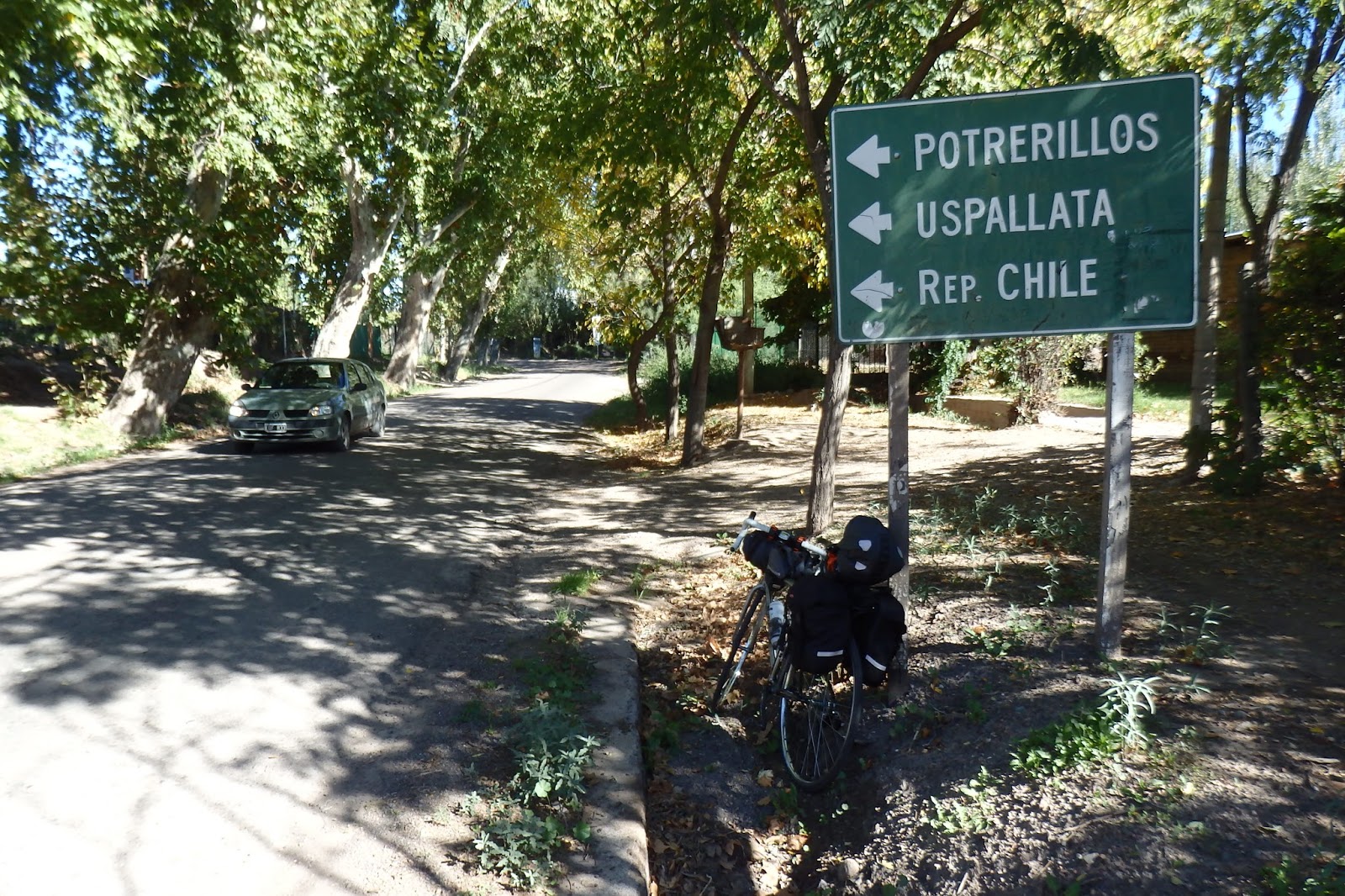
On the road to Potrerillos and beyond
After touring the small facility it was time to taste a lovely Chardonnay and two Malbecs, one from 2015 and the other from 2015. We learned how to swirl, sniff, and sip, and there were a few more spanish words that describe certain characteristics. Alas, one can't remember it all. Since the tour and the tasting were free I decided to spend the saved money on a nice bottle that later on I'd kill in the Acequias.

Calling the Acequias a B&B is stretching it a bit. Yes, there are beds (I ended up in one of eight bunks in a room that was for me alone, though), and yes, breakfast eventually materialized yesterday morning, but overall it was more of a backpacker's hostel than a quaint home-away-from-home. I didn't complain about the "shared" bathroom (really not much sharing but rather a climbing down th stairs and crossing the backyard to the outhouse) because Jonathan, the host, had accommodated my request to postpone my arrival by a day because of the huelga on Thursday. Overall, it was fairly clean, totally unluxurious, and definitely a throw-back to my youth.
One of the few places where a side road enter the main highway
It's a long, empty road ...
After one night I left the Acequias yesterday morning, heading southwest through Lujan del Cuyo toward the Andes. It didn't take very long before I caught the first glimpses of the cordillera in the far distance. Riding along vineyards, on bumpy roads lined by poplars and platane trees, the snow-covered Andes in the back and the yards' leaves turning reddish-brown--this was exactly what I had pictured when I had first thought about this trip. Iconic is probably the word to use here.

Lake Potretillos--or at least that's where it's located
After the first ten or so flat miles devoid of almost all traffic I finally reached the road, RN-7, that leads to Portrerillos, Uspallata, and finally Chile. It's a fairly wide, well-paved road that occasionally (in the climbing sections) branches out into four lanes, and the traffic is manageable, with lots of trucks taking goods to Chile. False flats and a steady, slight headwind started to reduce my speed, from 15 to 14 to 13 to 12 mph, and then the real climbing started. For the day, I climbed a bit more than 4,800 feet in 47 miles, which may not seem like much. But it was. Maybe I'm just getting really old, but it was a tough day; heck my average speed was less than 8 mph, quite likely a result of my having to walk several really steep unpaved pitches shortly before arriving at my destination for the next two nights.
Heading up into the valley toward Las Vegas, still 15 clicks away
Serpentine after serpentine, the views become more spectacular
But when facing such amazing scenery, plus tremendous sunshine and perfect temperatures in the low 70s, who cares? I know I was gong to make it, and I just took my sweet time. The gearing on the bike handled pretty much all ascents without a problem. My bailout gear is a 34/32, almost a 1:1 transmission, but I had to use it a few times, especially after turning off the main route and branching off into the valley that would eventually take me to Las Vegas.
The Rio Blanco comes straight from the mountains
The final 10 miles were a steady climb, until I topped out at about 6,400 feet and the asphalted road turned into dirt. After another 200 feet or so of elevation gain (involving more walking than riding) I had arrived at the Silver Cord B&B.
The Silver Cord B&B in Las Vegas, Mendoza Province
The term B&B harbors quaint and romantic notions for most people; at least it does so for me. And the Silver Cord (=silver-colored cordillera, get it?) doesn't disappointed. I was greeted by Sonia, the Argentine wife of Aussie co-host Adrian, with a pitcher of iced water and then coffee and home-mae pastries. My room is immaculate, the living area for the guests could come out of any interior designer magazine, and Sonia and Adrian are the perfect hosts. There are four other guests, an Aussie boy/girlfriend combo and an Argentine couple, and together we had a yummy home-coked meal. Since there are few (OK, essentially none) options to dine in Las Vegas the B&B also offers an optional dinner. And Adrian has a few decent bottle of wine for sale!
Gorgeous little Las Vegas
Today, after a scrumptious breakfast, I went for a three-hour hike in the vicinity. The vistas are simply breathtaking, and I am sure the photos speak for themselves. I am reminded of the Big Bend area and the Chihuahuan desert, but it is greener here. The soil is similarly rocky, and the plants are definitely desert plants. and of course, the Northern Mexico does not have snow-capped peaks!


Now it is late afternoon and the sun has vanished behind incoming clouds. The temperature dropped by an easy 10 F degrees almost instantly--well, we are at about 6,600 feet and winter is coming! Tomorrow I have a daunting 40 miles of dirt road ahead of me, and I hope that both the bike and I will be up for it. It's a lonely road, without settlements or services, and according to Adrian only occasional traffic. But If I want to make it to Tupangato by tomorrow night where my next hotel is set up, I'll have to go this way. Let's hope that no adventures await, that the sun comes back out, and the sharp rocks hide themselves.
The "boulevard" in Las Vegas
One of two main streets
PS: Adrian was just informed that his dad, almost 80, had a stroke this afternoon and he will have to leave for Mendoza. The weather has turned menacing, and if there is rain tonight or tomorrow I'm pretty much hosed. Stay tuned to how the trip continues.

Jürgen

Saturday, April 8, 2017

South of the Equator: Argentina, Take 1

Mendoza's wine-specific crest, modeled after that of Argentina itself
It was last fall that I was supposed to be here, during the Argentine spring instead of the early fall. But a broken clavicle kept me from this trip, which I had been thinking about for quite a while. On Wednesday afternoon, though, it finally was time to board a plane to start an almost three-week excursion to the land of Lionel Messi and the tango.
Cancellado ...
What was supposed to be an easy 18-hour trip to Mendoza turned into a two-day slog, thanks to a general strike in Argentina on Thursday that kept all airports shut. And so I spent a long day in Santiago de Chile, after a pleasant flight from DFW. Thank goodness for lounge access and status as it meant that the AA agent was able to snag a flight for me yesterday morning at 6:20 a.m., the only flight with a few seats left. With SCL airport hotel rooms rapidly filling up (and other hotels requiring long taxi rides), the value of belonging to several hotel loyalty programs (and having points in the bank) paid off when I landed a $250 room in the Airport Holiday Inn for a mere 20,000 IHG points. In other words, I lucked out.
French-inspired shopping gallery
US-inspired shopping gallery
The one-hour hop to Mendoza, just on the other side of the Andes as seen from Santiago, was bumpy yet uneventful. Unfortunately, it was still dark so that I couldn't see how close we came to scraping some peaks. Once in Mendoza, miracle-of-miracles, I was reunited with my luggage, something that always seems to be an issue in cases like this. Immigration and customs were smooth and pleasant, and then I was on Argentine soil. Just to remind me of the fact that this is South America, I found the only money changing place, a bank, shuttered in the busy terminal, and one of the two ATMs was out of service, while the other one was out of money. So much for getting set up with local currency.
Queuing for a working ATM on a Friday afternoon in post-strike Mendoza
Fortunately, the remise (a semi-official, unmarked taxi; Uber doesn't have a presence here yet) driver accepted the correct change in dollars, and for $13 I was hustled through busy streets to the Hotel America, where I had made a two-night reservation ahead of time. (I should note here that from the Admirals Club in Santiago I had been able to make several phone calls to Argentina to change my first three days' hotel reservations. I'm so glad that I speak enough Spanish for such transactions, and now I even know a new word, huelga, or strike.)
Mendoza's city center offers pedestrian zones and trees galore
The Hotel America is nothing fancy, but it is affordable at something like $75 for two nights, including a breakfast consisting of coffee, artificial orange juice, a croissant, a blob of butter, way too much jam, and several stale cookies. I rearranged the two tiny single beds in my room, giving me the space to assemble my Ritchey and still be comfortable. No, there is no shower head, but it's not an electrical shower like in Ecuador, either, yet the water is warmish. Best of all, it's fairly quiet and I will be able to leave my Ritchey's travel case here when I leave tomorrow, until the last night before my departure from Mendoza for the US.
Typical irrigation ditch in Mendoza
Unfortunately, the weather right now is not as glorious as it could be. After initial sun the clouds came out and it never warmed up beyond maybe 64 F. That meant that the beautiful tree-tunnel avenues of Mendoza didn't look as glorious as they would with just a few light accents. I walked around this provincial capital, which bustles with business (OK, it doesn't bustle at all during the siesta hour, which stretches from about 1 p.m. until around 5 p.m.). My hotel is about seven or eight blocks from the commercial heart of the city, an easy and pleasant walk.
Man-bun wearer and his mate and thermos with hot water
One of my first objectives was to get some local currency, and for a while I thought I might have some problems. The first few ATMs that I found were, you guessed it, either out of order or out of money. Was this a function of the huelga? Or maybe the upcoming weekend? Or just because? Who knows, but when I came across a 15-person queue in front of a bank with an ATM sign I immediately joined the patient crowd. Twenty minutes later I had the equivalent of about $260 in my pocket, or 4,000 pesos. Thanks to Lonely Planet and TripAdvisor I had learned back in the US that Argentine banks charge a whopping $7 transaction fee to withdraw any amount of money, and the limit is 2,000 pesos (or about $130). Thankfully, I own a Charles Schwab VISA card that refunds any ATM fees incurred. Now, that's a deal. Check it out if you travel abroad and worry about enriching banks.
Fairly ugly ...

... yet kinda pretty
In my preparations for this trip I had also learned about the "blue" market for currency. Nope, not black, blue. After certain political and fiscal reforms a few years ago the blue market pretty much ended and now one receives an only marginally better rate when exchanging a C-note with a street vendor. Actually, in my case it was a hustler who then took me to a gold & coin shop in some basement where I exchanged American for Argentine paper.
Happy chicks! The strike is over! Or something!
Now I have almost $400 of local currency in my pocket, and that's a good thing: Argentina does not appear to be cheap. It's not exorbitantly expensive, like Switzerland, but then, what is? Lunch menu prices are in line with those in the US, a chop of beer in a street cafe will set you back at least $3.50, and food prices in the local Carrefour were higher than those in Lubbock. Maybe that's why they went on strike? Rampant inflation and no equalizer? But then, when I went out for dinner late last night, the cafes, bars, and restaurants were crowded with mainly young people. Go figure.
It's 25 pesos for the shoe shine, not dollars--it comes to US$1.65
Talking about last night: There's definitely Spanish blood coursing through the Argentinos' veins! I thought I might be late starting dinner around 9:30 p.m., but that's when the locals are just getting ready to think about going out! When I left my restaurant, El Palenque, at shortly after 11:00 p.m. the tables were finally starting to fill up. Wow! My dinner, by the way, was a nice steak with a mushroom topping and something that seemed to be a cheese-smothered potato, only that it didn't really taste like a potato. For my beverage I had chosen the house wine for the simple reason that it was served in a half-liter ceramic penguin! Looking at that penguin while watching Mendoza's young and pretty saunter by more than made up for the quality of the wine. Total cost for the meal was $17, which would have been the same at lunch time. So maybe it's lunches that are comparatively expensive and dinner is normal.
Steak and Peguin

On the way back to the hotel I passed by a small place called El Botellon. What I had first assumed was a pub would turn out to be a growler refill station for craft beers. It was still open at midnight, and so I entered and immediately was told of my mistaken initial impression. Never mind, the young and skinny keeper of the establishment and his one-and-only customer were drinking from plastic cups, and they assured me that it was late and that I could try some beer, too. What ensued was a massive sampling of all eight styles of beer that were on tap, starting with a Blonde all the way to a Steam Stout. Of course, I didn't sample in that logical progression but rather according to the whim of the kid. I can honesty say that the two IPAs had nothing to do with IPAs that I have drunk, except that they were also called IPAs. The Bitter was drinkable, and the Trigo, or wheat, was close to being enjoyable. Another two customers, with their growlers in a chicque wooden crate, joined us and the conversation turned from Spanish to English. Dang, I really can't say much about beer in the local idiom. I was told that in Mendoza province alone there are something like 40 craft breweries, and they are all stellar (👎), but the best Argentine craft beers come from Patagonia, mainly because the water is great and there are lots of Germans (👌).

On that happy note I finally took my leave and thought how cool these first two-and-a-half days of my trip have been. And now it is time to get on the Ritchey and do a little Saturday morning reconnaissance ride.

Jürgen