Thursday, January 23, 2014

El Cajas National Park—hiking at 3,800 meters


This really was supposed to be the blog entry about food and other good stuff, but I had such an unbelievably great time today on my excursion to the El Cajas National Park that I simply have to write about it.
Driving through an Alpine valley toward the cloud forest
During my city bus tour yesterday the guide had mentioned the possibility of a trip to the national park, and I had been able to talk a couple from Montana, Bob and Julie, into booking the same trip—we needed a minimum of three people to make the excursion happen. When I showed up at 8:50 this morning at the cathedral, our guide, Miguel, and Bob and Julie were already waiting, so off we went. It was about a 40-minute uphill drive from Cuenca (about 2,500 meters elevation) to the base of the real climb. Here we tanked up on coffee, and I bought some Oreos, in case we were going to be caught by unforeseen circumstances.
Our starting point was above this lake
The driver of our modern van took us all the way up to the highest spot of the road that leads on to Guayaquil. At exactly 4,167 meters (or 13,671 feet), this must have been one of the highest roads I've ever been on. Up here one is on the altiplano, the treeless sponge that regulates Ecuador's water supply. Precipitation (rain or simple clouds and fog) on the west side of the Continental Divide will flow into the Pacific; on the eastern side, all the water eventually collects into the Amazon basin and dumps out into the Atlantic, more than 5,000 kilometers away. Quite a humbling thought when one sees the small waterfalls and lakes and rivulets. We drove back down for about 300 meters elevation loss and then started our walk. Yesterday, it had sounded as if we'd go for a pleasant walk around some lake—but the truth was that we were about to embark on a 3-hour, 7-mile hike that bordered on trekking.


At about 12,500 feet one can feel every little incline, and even walking downhill requires more effort than one would suspect. Miguel, himself around the 60-year-mark, made sure that we paced ourselves, with many stops and the opportunity to look around. After the first kilometer or so, our small group was alone, and we didn't see anybody else except for two fishermen in the distance. The soil is moist, cushioning every step in a pleasant way. In some spots it felt as if we were walking on a sponge, and in a few places we had to be careful to not slip in muddy sections. There were lakes everywhere, some large, some tiny, and rivulets were babbling along. Wherever one looked, there were small waterfalls, and the sound of running water was ever present.


It was a good thing that we had to walk at an easy pace and stop often because it allowed us to really look around and notice all those tiny little flowers and plants that dot the ground. There was one plant that looked like a dandelion, but it had no stem and the blossom was stuck to some flat leaves; the same was true for the daisies—no stem. Next to the flowers were lichen-like plants that were soft to the touch and reminded me of star-like patterns one finds in baroque church ornamentation. It was a foreign world with a ground-hugging flora that would suddenly explode into color, only to meld back into all shades of green.


We did walk through a small stretch of forest. These were quinoa trees, which don't have anything to do with the fashionable grainy stuff that health-foodies like so much. The tree is called in Spanish arbol de papel, or paper tree, because of its bark that flakes off like the layers of a croissant—seriously, they should call it croissant tree! These odd creatures were between 300 to 500 years old, all gnarly and twisted in inexplicable patters. The bark reminded me of that of madrone trees that also lose their outer layers.


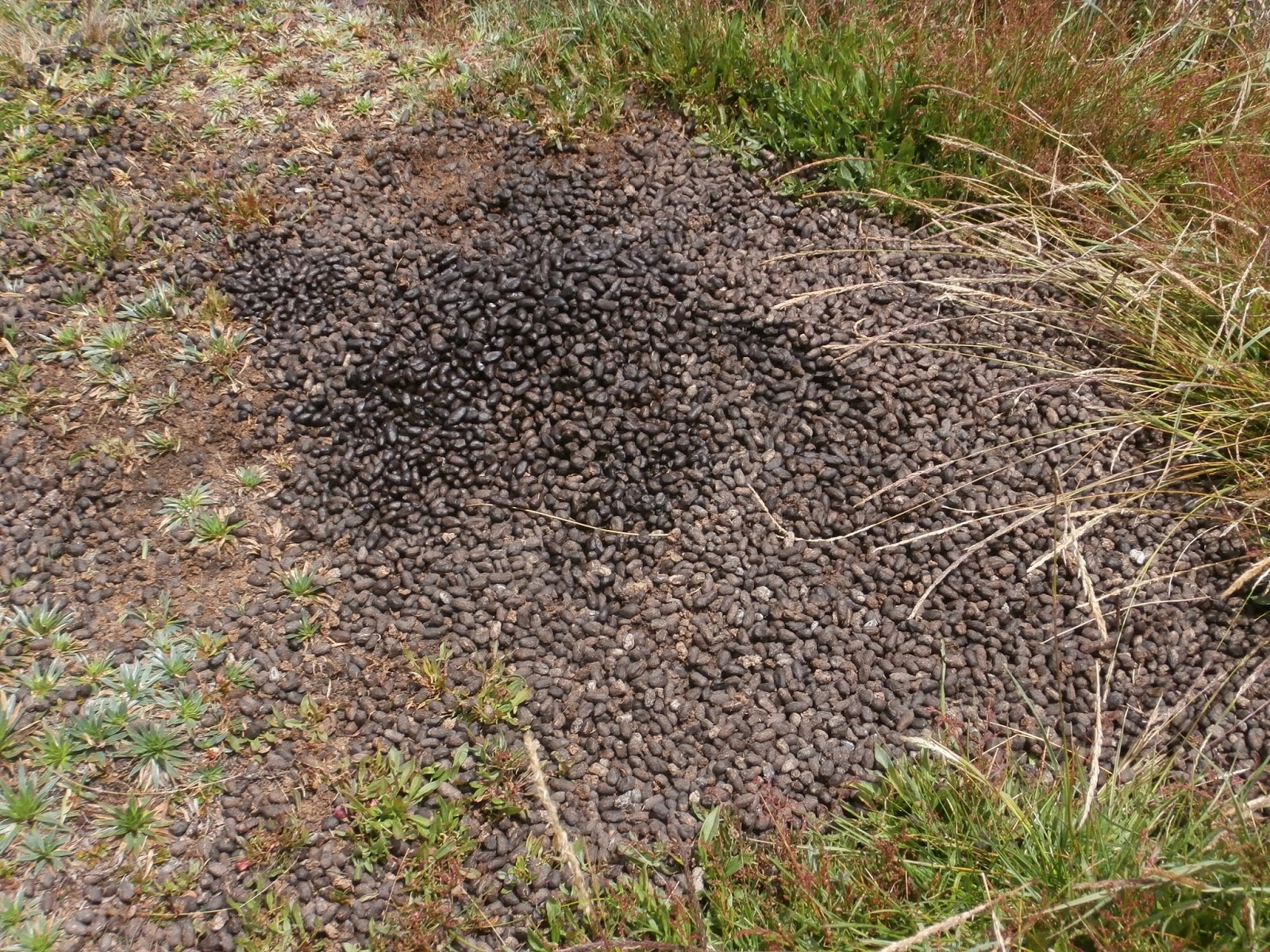
We didn't see any wildlife except a few tiny birds, but we did come across a healthy pile of something resembling dog shit; Miguel told us that it was the "poo" of the lobo de la montana. A while later, some not-so-inviting smell alerted us to the rabbit-like droppings of alpacas, the cousins of llamas that like to crap in the same spot over and over again.
The lobo de la montana craps big'uns ...
... and the alpaca produces coffee-bean sized pellets
The weather steadily improved, and finally the sun came out and we could shed a few layers. It was simply gorgeous. I was so glad that my knee was holding up, and I have decided that I will check out a trekking trip in Argentina that I had read an article about. And then there is Kilimanjaro, something on my own, secret bucket list. That leg behaved!


After about three hours we finally got back to the road, at a somewhat lower elevation than where we had started. Our driver was waiting for us, and the four of us piled into the van. Included in the $50 price for this tour was our lunch, which we ate in a scenic restaurant at our original starting point. We were greeted with a canelazo, a tart yet sweet, slightly alcoholic drink that's served warm, made from a particular plant the name of which escapes me (I later happened to see it in a street vendor's basket). This was followed by one of the best potato soups I ever had, with lots of fresh corn kernels and a generous slice of avocado in it. And the main course was trout—the others went for the pan-fried kind while I opted for the steamed version, with a garlic-cream sauce. Delicious.

With guide Miguelito
 

After lunch, we drove back down the mountain to Cuenca. On the way we saw some wild llamas on the road, and the vistas were reminiscent of a drive through the Alps. I have to say that our group was perfect: Julie, Bob, and I really hit it off, as if we had known each other for years. And Miguel was the perfect guide—not overbearing, full of interesting information, with a good sense of humor, and just the kind of attitude that actually makes you want to tip him. If you ever need a personal guide—who has been trained by the ministry of tourism—whilst in Cuenca, he can be reached at 099 820 6423, or miketours1@hotmail.com. I hope you enjoyed the photos of my excursion to the paramo, and I hope that you will—someday—get a chance to see this amazing place yourselves.
The paramo at its best
And I promise, the food entry will come—this afternoon I collected a little bit more material for the Epicurean's Guide to Ecuadoran Cuy-sine.
 
Jürgen

Wednesday, January 22, 2014

South of the equator: Quito and Cuenca


Almost a week ago I left Lubbock on my first trip of the year. After 16 continuous days in the Hub City, it was about time to change the scenery, just a tad at least. American Airlines reliably transported me to Quito, Ecuador, just a smidgen south of the equator, and yes, the scenery was indeed different.
The venue of the races that I attended
I had been to Ecuador before, once riding my Bike Friday for about a month all over the northern part of the country, and the second time together with Judy, hitting some of the most scenic little towns and markets in the highlands. Both of those trips took place in the ‘90s. Now, about 15 years later, change is evident down here, too: The trucks belch out less pollution, there are many more new, expensive cars on the streets, and the denomination no longer is the Sucre but rather the Dollar.
The nature of competition: One second in the lead ...
... and the next on the ground
The reason for my going to Quito was an assignment to a bike race, and for a few days I was busy with that. I met some very nice people, among them the chancellor of one of the private universities here, UIDE, and the head of the fledgling English department at the university. We talked about the possibility of teaching here for a semester or two, and in the coming months I will certainly look into this, although my 2014 schedule is already chockfull until the fall. We’ll see.
Tempers flared at the awards, and the law was dispatched
Post-race plastic water bottle recycling
The race was interesting. I have always enjoyed the South- and Latin American mentality as far as time and obligations are concerned. A lot of nodding will accompany one’s request for this or that, but when the time gets close for delivery, nothing will have happened. With the clock ticking, and the pressure mounting, action suddenly starts up, and before you know it, whatever looked impossible just 15 minutes ago has been delivered, after all. And so it was here as well. One just needs to have faith. Lots.
Ingenious electrical work in front of my hotel window
Election time in Ecuador—no shootings were reported

I did not stay in Quito proper but rather in one of the surrounding ‘burbs or whatever one wants to call Cumbaya. It is closer to the newly built airport than Quito, and the hotel was only 25 minutes from the venue while accommodations in Quito would have meant an hour or more in stop-and-go traffic. There was nothing scenic about Cumbaya, and the hotel was noisy yet clean. This was, after all, a business trip. A driver would pick me up at the hotel, drive me to the UIDE campus where the track was located, and at the end of the day I’d be chauffeured back to Cumbaya. An easy life!
Felipe, Loyal, Carlos, moi, and Peter, after the race
Modern bike rack in Cumbaya
Students at the San Francisco de Quito university relax with a bit of beer
On Monday, after finishing off the business side of the trip, I took a flight on TAME from Quito to Cuenca, a city in the southern part of Ecuador that I had not visited before. As a World Heritage City, Cuenca often is referred to as the “Athens of Ecuador” for its nice climate and pretty colonial architecture. Here I was going to while away three more days before returning on Thursday to the US. Well, this plan has been modified as my Thursday flight out of Cuenca, on LAN Ecuador, has been cancelled, and American had to rebook me for a Friday return. So, I will spend an extra night here in the lovely Hotel de las Rosas. American has already remunerated me with a flight voucher worth $300 for my next flight. That pretty much takes care of my four-day private vacation.
The one-hour flight cost $45
Approaching Cuenca—the airport is in the middle of town
I thought we were going to land on somebody's roof!
Today is Wednesday, and I am writing part of this blog entry after having my breakfast in this wonderful little hotel. I had chosen it before coming down here based on Tripadvisor reviews, and I have to say: well worth the money! The days of finding a clean and comfortable hotel for $10 here in Ecuador are over, and the $55 that I pay per night is definitely on the upper scale of prices. But (after a first night facing the street) I have been put into an incredibly nice room with a comfortable bed, superior bathroom, and private roof-top terrace that couldn’t be much better. It is quiet, and the noise from the city no longer bothers me. (That was definitely a problem in Cumbaya as well, where I had to sleep with ear-plugs.) When one returns from sightseeing in the afternoon, fruit, cake and a fresh cup of coffee wait, and at night they lovingly put a hot-water bottle into one’s bed! The breakfast is outstanding, the people super-friendly, and only the internet has incessant hiccups that make checking e-mail and posting blog entries a bit of a pain.
My room in the Casa de las Rosas
This particular entry will not feature any references or pictures related to food or drink—that will be reserved for my second Ecuador blog entry. Rather, I’ll try to let you know what one can do around here and what there is to see. Cuenca was founded in 1557 by the Spaniards, so much of the architecture and of course the layout of at least the old part of town reflects that. When I flew in I could see all those big churches sticking out of the sea of red tile roofs. Narrow streets, incessant bus, taxi, and private traffic, pedestrians, street vendors, and stray dogs all mingle. The hair is dark, and the faces more often than not mestizo or indigenous. It's your typical South American street scene: seeming chaos that is well regulated. After now two days and many walks I have figured out that the street vendors have their own spots, that the policemen really don't do anything but be present, and that the beggars beg along established routes. It's nice to be in a place and start noticing the routines so quickly.
A guinea pig rotisserie for your backyard BBQ enjoyment
The fruit selection is amazing
Potatoes anyone?
Yesterday, on my first full day here in Cuenca, I spent most of the day walking around, visiting various museums. The major one is the Museo Pumapungo, which has a fabulous ethnographic collection. Man, the diversity of indigenous cultures down here is mind boggling! There are the highlands, there's the coast, and then of course there is el oriente, the tropical rainforests on the east side of the Andes that are part of the vast Amazon basin. Even now, there are small enclaves of tribes with fewer than a 1,000 members in fairly close proximity of Quito and other large cities. I found all this extremely fascinating. Here we are in the 3rd millenium, and there are real "Indians" just a few kilometers away! Actually, one can see them in the market, too, but the ones that come to town regularly obviously have been much assimilated.
Picture of a photo of one of the tribes—los Tsatchila-colorados
Another thing that intrigued me was the symbiosis between man and nature in these cultures—the way the communities work their land, the way they feed, clothe, and cure themselves. There is so much that is on the brink of extinction, and it's so easy to forget that sitting in our smug little houses in the civilized world.
The museum has a wide range of exhibits
What would talking about Amazonian tribes be without mentioning shrunken heads, right? Well, the Museo Pumapungo did not disappoint: On display were four or five tsantsas. I didn't know anything about the Shuar culture, which is responsible for all those gruesome tales. For one, women, children, and white people were never shrunk because the Shuar deemed all of them inferior. Heads were only taken (and then shrunk) in retribution for an illegal killing of a person. Obviously there are a bunch of rituals, shamanism, and hallucinogenics involved in the whole thing. If you want more info, you should be able to Google those two terms, or just come down here and visit the museo.
Shrunken head from the Shuar culture
This (free!) museum is built on the grounds of the old Tumipampa or Tomebamba, as the Inca referred to this site. Earlier it had been inhabited by the Canari, who called it Guapdondelig. The few ruins are well restored and maintained, and large gardens and even exhibits of local birds round out this feeling of being moved back into a different world. This museum is highly recommendable, and I didn't even mention some of the modern art.
Fausto Bravo's Tres Marias, in the Museo Pumapungo
So, in the interest of the reader who has already spent 20 minutes poring over this and the progress of time here this morning, let me close things down for today (especially since the internet connection has horrible hick-ups): So far I have spent 1 1/2 immensely enjoyable days here in Cuenca, and there is more to come. Tune back in for a food-dedicated entry in the next day or two—you won't be disappointed. And please check out a few more of the pics below.


Jürgen


Tuesday, January 14, 2014

2014 has started with lots of riding, cold, wind, sun

Lubbock now has had be back for more than a fortnight, as they say in Britain, and before I start my year's travel with a trip to Ecuador on Thursday I thought I'd provide a quick update, lest my faithful followers and itinerant readers might think I've fallen off The End of the World ...
The End of the World

Yes, this is what I call affectionately The End of the World. It is the turn-around point for a 35-miler that I like to ride when the wind comes from the southwest. One rides on this long, narrow strip of asphalt, encountering more dogs than cars (currently there are two mean ones, and one behind a fence). The road seems to go on forever until it somehow vanishes right over the horizon, with nothing but brownery behind. One could think one is going to fall off The End of the World. And then one goes down a tiny little slope and the asphalt ends. Fortunately, a stop sign tells the traveler what to do.

I've been riding a lot. When I got back from Europe late on January 30, I knew it'd be a long slog back to fitness. On my first ride, on New Year's Eve, I was honestly wondering why I felt like total dogshit—until it hit me that, duh!!!!, that I felt the remnants of the cold that had really hit me hard while in Berlin, the long flight the day before, the usual amount of alcoholic beverages over the holidays, the total lack of riding for more than two weeks, and—could that maybe be the true culprit?—my having been totally out of shape even before I left for Europe! So, no wonder I felt abjectly horrible on the bike.
The mostly gravel-road Southland Loop
We rang in the New Year with a Feuerzangenbowle at Wes and Susan's—and a 1 p.m. ride of the Southland Loop with Bobby's group just a few hours later. That morning, all hung over, I transformed my non-operational 8-speed 'crossbike within one hour into a functioning 9-speed, all with used parts. Whew! On that 43-miler I felt as crappy as the day before, but for now-known reasons plus the effects of the Feuerzangenbowle the night before. We grow older, but we don't learn, it seems....

Despite heavy winds (OMG, one day it blew dust and all I could do was use the commuter to ride 20 miles through town buying hard-to-find groceries for a fancy dinner) and at times bitterly cold temperatures, I have ridden every day except one (that was when we hit something like 11 F and the flags were  blowing stiff as boards). Just this morning I convinced myself that I could beat the wind by going out early and riding first into it, and I ended up with 46 miles while normal people sat in their warm offices and worked. Ah, the cruelty of being retired and being cursed to a life of leisure and cold, windy bike rides.

If my plans work out, tomorrow I'll add another 35 miles or so to the 477 miles since December 30 before boarding my first flight of the new year on Thursday morning. Let's see whether I can keep off some of the three or four pounds I have lost over the past two weeks. I feel as if I am living on an eternal weight roller coaster.
Canada geese at the "tank" in my 'hood
Aside from riding my little heart out I've been doing a few things around the house (but not too many!), taking the occasional walk, and making nice dinners either for myself or for dinner guests. I've been playing with some new recipes, and that's been really satisfying: creating something yummy in that perfect kitchen that I so love. So, overall it's been a good start to the new year, and the upcoming trip to Ecuador will of course be a first highlight. Stay tuned for a travel report in the next few days, time permitting.

Jürgen