Tuesday, November 6, 2012

Traveling in the Alto Adige (Südtirol)

After I had hopped across the pond a week ago (or at least started the trip on Tuesday and arrived on Wednesday in Munich/Freising), Sabine and I chartered her little white Skoda and headed for Austria and beyond on Thursday. Along the way it occurred to me that I hadn't slept for two consecutive nights in the same bed for more than a week.

Taking the Autobahn, it's less than an hour from Sabine's place to the first "real" mountains in the Alps, and we were greeted by blue skies and vibrant fall colors.
Looking out of the window shortly before the Austrian border at Kufstein
Only stopping to buy the obligatory 10-day pass ("Vignette") for the Austrian Autobahn for 8 euro, and shelling out another 16 euro for the two-way permit to cross the Brenner Pass between Austria and Italy, we bypassed Innsbruck and headed into the clouds south of the highest mountains in this region of the Alps. The plan had been to spend three days in the Alto Adige, a sun-blessed region of Italy in the Dolomites that is so warm that banana trees and vineyards prosper while a few kilometers to the north the denizens run around in fur coats. But the tables were turned on us: Südtirol was hidden in clouds and fog for two of the three days we were there, while strong southerly winds cleared out the northern portion of the mountains. Thus it goes.
Even fog can create spectacular images—Seilbahn between Ritten and Bolzano
But we had fun nevertheless. For one glorious day in Bolzano (or Bozen, in German), we enjoyed sunshine and mild temperatures. The sights were spectacular, and both of us are certain that we will have to come back. This interesting region, annexed by Italy after the first World War in 1919, still is heavily influenced by the Austrian/German culture, with all official signage in both Italian and German, has little if any to do with the poverty-stricken South of Italy or the industrial areas of the North. Prosperity oozes from the area, with beautiful villas set in vineyards and people shopping in expensive boutiques. The vegetation is at times Mediterranean, and orchards abound. At the same time, the wild and snow-covered Dolomites loom just a few miles away.
Bolzano, with the Rosengarten range of the Dolomites in the background
Located smack-dab in the middle of the commerce routes that since the Middle Ages were used to pass goods between the north and the south, this area prospered early. Add to that the perfect climate that allowed the cultivation of grapes, and one can understand why there are so many estates, mansions, and castles. Reinhold Messner, the well-renowned Austrian climber, owns his own little chateau somewhere around the area. When I make my next million, I may just consider doing the same....
Burg Runkelstein, one of many castles in the area
Runkelstein features secular frescoes of life in the Middle Ages
Need a castle? Südtirol has them!
We spent one night close to Bolzano and then moved on for two nights in an amazingly well-appointed apartment in Merano, just about 30 kilometers away. Unfortunately the weather started to turn sour on Saturday, even though it stayed dry and we were able to go on a long hike through the beautiful countryside. We snooped around town and drooled over all the savory specialties in the stores. And if I get to taste the beers in three different independent brew houses (one dating back to the 13th century), well, then my life is nothing but happiness. Batzen, Hopfen & Co., and the Buschenwirtschaft Pfefferlechner all had unfiltered suds and old-world atmosphere. Who cares about the weather?
Filling a growler at Hopfen & Co. in Bolzano
Industrial-caliber slicing equipment
Local mountain cheese
Can you smell it?
Relaxing at the Pfefferlechner in Lana, outside of Merano
On Sunday morning we headed back to Munich, seeing a bunch of snow through the fog at the top of the Jauffenpass—by our standards not much of a pass at barely 6,000 feet, but one of the higher ones in the Alps. Once we made it back across the Brenner the skies lifted, and we decided on a final stop at the Tegernsee, a posh area on the fringes of the mountains that attracts tourists galore, especially on a last nice fall Sunday.
The Tegernsee in Bavaria
Last night (Monday) I boarded an Air Berlin flight to Berlin, where I am now spending a few days with my dad before heading back to Munich later on in the week. I'm going to spend the next three nights in the same bed! Wow!

Jürgen

Wednesday, October 31, 2012

... and Luxury

My Triple 7 last night—I looked out of three of the windows right below the C
Call me a three-percenter, even if only for a day. Cashing in 125,000 miles for a First Class freebie ticket to Europe gets you close to the 1% that everyone talks about. Not quite, but close. You get to board even earlier than the top-tier frequent fliers (which I am), the service is a bit more attentive, they give you PJs on the airplane, and the purser makes up your fully flat bed. I've roughed it many a time—some of you may know the story of my train trip from Bari to Rome, curled up in the stinky toilet of a clickety-clackety train in Italy. If I need to, I can subsist on very little. But when the opportunity arises, I will seize it. Yes, I enjoyed my spa-shower this morning here at Heathrow, and my scrambled eggs and smoked salmon in the first-class-only Concorde Room was quite the thing. I work, and I work the system, and I enjoy what is offered. And if there's a bit of luxury to be enjoyed, well, so be it. But believe me, I never take it for granted, and I always remember who I am—even though I am wearing nicely polished leather shoes just for the occasion.
Looking from the Concorde Room onto Heathrow's activity
Time to get ready for my up-front flight to Munich.

Jürgen

Tuesday, October 30, 2012

Freedom ...

While driving back from Waco after officiating the Bicycles Outback Fallout mountain bike race this weekend, a deep feeling of freedom overcame me. This was my last scheduled race of the season, I was sitting in the little green Miata, and the peaceful world allowed me to pass through it. It was Monday morning, as I had stayed in Abilene for the night after not leaving Waco until 5:30 p.m. on Sunday after a long day that had started at the same time, but a.m. I could not help but feel satisfaction looking back at the race, working with good people, giving encouragement to an upcoming race official (Matt), resolving some issues, and knowing that for the most part we had all done a good job.
Renewable energy sources around the Snyder, TX, area
I also had to think of my upcoming trip to Germany, with my departure from Lubbock scheduled less than 30 hours later. (As it is, I am writing this entry from one of American's lounges in DFW). Looking at the windmills on the ridge from Abilene to Sweetwater, and later those around Roscoe and Snyder, I felt free and happy. Another season behind me, another great trip coming up, another Monday morning when I did not have to punch a clock like most regular folks my age have to. It's not that I feel thankful to any one particular person or—you know me better than that—some nebulous entity: I am responsible for my own good decisions, my frugality, and my having worked hard (as was my cohort Judy) that all have resulted in my retirement at age 54 and living a life that has the F-word all over it. Free to travel, free to pick jobs, free to drink a bottle of wine when I want, free to choose whatever I want to choose. It's a deeply satisfying state of mind.
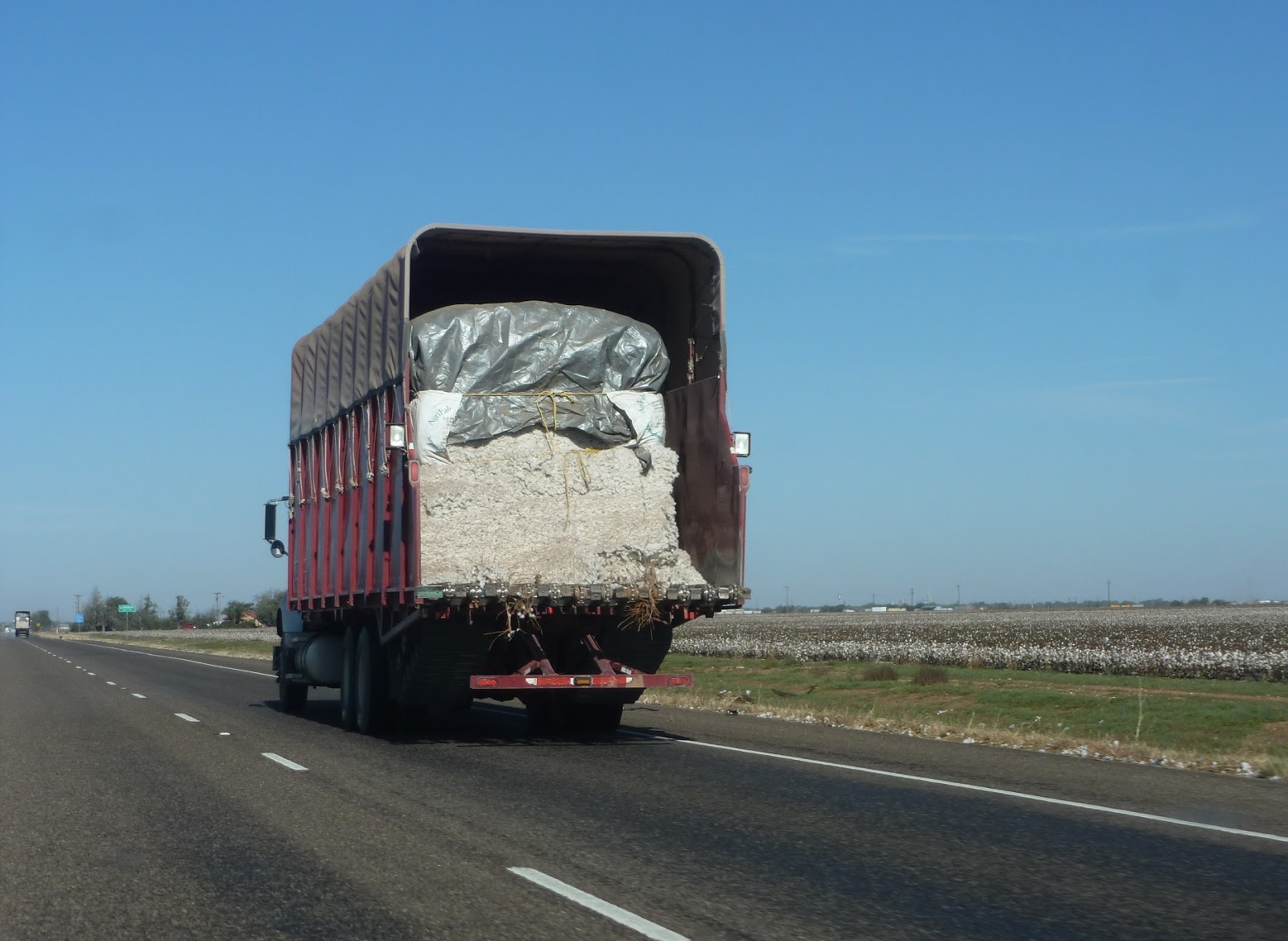
Cotton modules traveling to the gin—a sure sign my season is coming to an end
Being able to do most of the things that I want (well, within reason) is not something that I take for granted. I know how fleeting good health and material wellness are. Life is fickle, and we're all just one inattentive driver, one mariposa moment away from alteration of direction or even cessation. Judy's death—but also our time together, which was so well-spent—crystallized for me even more that it is up to me to seize life and enjoy its freedoms, and I suppose that somehow Monday morning's drive back home brought all of this once again to the forefront.
Spin, baby, spin ...
When I came home from my last day of lectures at TTU, Judy had left me that beautiful, hand-written note, lying on the floor so that I couldn't miss it. It's framed now, of course, and it keeps reminding me of what I know and keep reminding myself of: I am "Free at last!"


Jürgen

Monday, October 22, 2012

It's fall, and thus time for Collegiate Nationals

Brilliant aspen leaves scream Fall in New Mexico!
One of the recurring highlights of my officiating year has been my appointment as Chief Referee of USAC's Collegiate Mountain Bike National Championships over these past few seasons. It all started out in 2009 when USA Cycling sent me to Northstar (Tahoe area) to clean up what had become a debauchery fest. Somehow I managed to lead a race where we were not kicked out of the venue after the three-day run. I was supposed to return to Northstar in 2010 but had to turn down the assignment with just a few weeks to go when Judy was in the hospital. Thankfully, I was assigned again in 2011, when we had the epic snow-and-ice races in Angel Fire, and now I am looking back on a second successful year in this beautiful New Mexican ski resort. What a wonderful weekend (really, week) it has been.
On the road from Las Vegas (NM) to Mora
I left Lubbock last Tuesday and stayed overnight in the Santa Rosa Hampton, where I am also staying tonight after an exhausting last day of racing. Wednesday morning I drove up to AF, via the beautiful Mora valley. It was warm enough to drop the Miata's roof, and I was grinning from ear to ear.
Fahrvergnügen—and it's not even a German car!
I spent the rest of Wednesday with course inspections and similar preparatory work. In the evening, several USAC staffers, Cath and Jon of CJ timing (whom Sabine and I had visited in Telluride just a few weeks back), and I had a pizza-and-beer party in my room in the Angel Fire Resort because I was the only one who had a kitchenette with a real oven.
Thursday morning's start of the Division 1 Men's Short Track
On Thursday, more course work was due, and slowly racers and officials started to trickle in. At 6:15 p.m., sharp, I started my first official racers' meeting (a nightly affair), and the race weekend had begun. Friday and Saturday were pretty damn long work days, with about 11 hours of work each day. But we were so lucky: This year, the weather more than cooperated. The mornings may have been cold, but once the sun came up the temperatures quickly rose into the high 60s, low 70s, and we hardly saw a cloud all weekend. My crew was rock solid and hard working—Arin R. was Vice, Michael D. Starter, Boris D. Finish Judge, and Jacque P. Secretary. In addition, Pamala T. from Albuquerque volunteered her services, and she was not only a welcome but a most valuable addition to the crew. They all worked hard, and there's nothing wrong with a power-nap when the opportunity arises during a 3-minute break in the Downhill starts.
8,600 feet of elevation and dehydration can knock out even the best
Seriously, working a race like this requires stamina. I don't know how many miles I walked or how many feet of elevation change I clocked. Tonight, here in the Hampton Inn in Santa Rosa, I went into the hot tub and it felt soooo good! And not always is taking the skilift to the top of the mountain and then hiking halfway back down to the start of the downhill as easy as it might sound.
Walking the Downhill course
Collegiate Nationals would be only half as much fun if it weren't for some of the not-so-serious aspects of the weekend. Saturday's Awards Banquet can become a little rowdy, but this year there was a noticeable lack of inebriation, and all the fun was in good taste—well, Topher the big-breasted blow-up doll (with the likeness of a conference director or something like that plastered on her vinyl visage) was maybe a bit on the risqué side, but at least she wore a bikini—something that had been absent during her performance during the Downhill race. Topher shared the stage with all winners and runners-up, and the students' attire differed only slightly (on the more modest side, but still outside of what one would expect at most National Championships).
Topher's top kept sliding off
To be a college student once again!
But it wasn't just the students who hatched mischief: Even USAC can do so, which certainly speaks for the organization. During today's break between the Qualifiers and the Finals of the Dual Slalom, USAC had scheduled the Post Grape Nut Eating Challenge. You need to know that a) Post Grape Nuts cereal is one of USAC's sponsors for all National Championships, and b) Post Grape Nuts cereal has the flavor of paper-maché and the consistency of concrete once it has been mixed up with milk. The "Challenge" consists of having to somehow wolf down the contents of an entire box of Post Grape Nuts as quickly as possible, without barfing it up or rupturing once stomach in the process. Until today, the World Record had stood at 47 minutes, set by a USAC intern in what one could easily call a hazing incident. Well, four young racers signed up this morning to try to win an entire case of Grape Nuts, and two win two cases if a new record would be set. Believe it or not, the old standard was totally obliterated with a new best of less than 14 minuets (yes, for a 24 oz. box of that stuff!) Joey Chestnut, the perennial hot-dog-eating champion, has nothing on that kid! The techniques that were displayed by the various contestants were a sight to behold, as were the sordid faces of those grape-nutty kids.
Four young college students working on their fiber intake
One technique involved liquifying the cereal in the bag and then trying to drink it
One more spoonful and I will barf!!!
And so it was another good Nationals. I was tickled with the performance of my crew and how smoothly things ran. Sure, there are always a few hick-ups, but when racer after racer, and coach after coach, tells you how well everything ran, well, you got to believe it. If it hadn't been for several crashes (and a few transports to the Taos hospital), everything would have been perfect. But that's mountain biking for you, and not even young folks are immune from injury. It looks as if everybody will be OK (although the fella with the ruptured spleen [no, not a Grape Nut Challenge contestant!] and the bruised lung faces a long journey back to Florida), and I hope they will all return to next year's race. And I hope the same for myself.

Jürgen

Friday, October 12, 2012

In the land of giant falling arrows

To continue some of the home turf coverage, I want to show you some images that I encounter when I go for my (almost) daily rides when I am at home. Tuesday was an especially nice day (today it's rather dreary, and yesterday it blew like the dickens), so I took the camera along.
Calling New Home a "city" is stretching it a bit
My usual 35-mile ride takes me to the hamlet of New Home, due south of Lubbock. There are two curves in the road, and that's the only time one has to watch out as not miss the proper path. Along the way, one comes across wonders such a plam trees in the semi-desert.
Are they real, or are they Memorex?
We have other crops, too, most notably cotton. The seeds are planted in the spring, with the first green showing around May. By late summer, the fields are a lush green and the first blossoms appear, which soon develop into bolls. They then break open, and the fluffy stuff emerges. To harvest the cotton, the leaves must have fallen off the plants—either because they've been hit with the first hard freeze (typically on October 31 here on the South Plains, but freakishly enough in such a hot year last Monday morning) or more often because defoliant has been sprayed on the fields, a la Vietnam.This time of the year one sees still-live plants adjacent to a defoliated field.
Cotton that's still alive ...
... and cotton after the Vietnam treatment
Another crop that catches the eye is sorghum. This grain starts out all green but then, with advancing maturity, changes into gold and orange tones before settling on a deep rust color. Quite pretty!
The 50 Shades of Sorghum
A few rogue cotton plants survive alongside the sorghum
What about other colors, you ask? You have to look, carefully, but there are splotches everywhere, even coming out of the asphalt.
(Please send me your taxonomic description for this plant)
Once you make it to New Home, the local high school welcomes you with a big sign. The focal center of social interaction in town is the The Last Maverick restaurant, a diner that is about 50 years out of place (or are we?). And if you don't watch out, you may just get speared by one of those giant arrows that fall out of the sky occasionally.
How the heck did they decide on leopards as mascots?
The Last Maverick, a place of true culinary delight
Beware of the giant arrows—and you should see the Indians shooting them!
So why in the world would I want to live and ride anywhere else with so much excitement on just one short 35-mile ride, huh? OK, time to saddle up the horse and go back out to New Home, just to make sure the population count hasn't changed.


Jürgen

Sunday, September 30, 2012

Lubbock's Silent Wings Museum

It's not often that I post things about Lubbock—and part of that may be that I see so many exciting things while I travel. But yesterday's visit to our Silent Wings Museum, located in the old terminal building of our airport, deserves an entry of its own.
The museum is housed in the old terminal building on the west side of Lubbock International
For years I had thought about coming out to this museum, but for one reason or another I had never made it. But with an invitation to take advantage of Smithsonian Magazine's "Museum Day Live!" offer of  free entry to various museums I decided to save $5 in admittance (you know how as retirees on a fixed income we have to count every penny) and turn a wet and dreary Saturday into a cultural experience. I had a vague idea that Lubbock at one point had been a training center for military glider pilots, but I had no inkling how big this program was during a few years of World War II or what important roles it played during the invasion of Normandy or the Battle of the Bulge, among others.
One of many educational interpretive displays at Silent Wings
Altogether, almost 14,000 (!) CG-4A combat gliders were built and deployed (and many, many of them lost in what were often slightly better than suicide missions) between 1942 and 1945, and most of the pilots were trained at Lubbock's SPAAF (South Plains Army Airfield), one of three airports in the city at that time.
The display shows two soldiers opening the CG-4A's cockpit to unload a jeep
The bare-bones cockpit of the CG-4A
The payload sat right behind the pilots
The gliders were amazingly large with a wingspan of almost 90 feet. They could carry a jeep, several troops, ammunition, and other supplies; the army even developed a small bulldozer (which is also on display) that could be flown in to improve landing sites quickly. The skeleton of the planes was made of steel, but it was simple canvas that was stretched over the fuselage, making it possible for enemy flak to easily penetrate the CG-4A. The gliders were pulled by C-47 transports until they were within reach of their target sites—yet still out of range to be detected by the enemy—and then released on a no-return-possible mission that often ended in crashes and tragedy. The front of the plane was equipped with ski-like runners to make it possible to land in rough terrain.
The CG-4A is the large plane
As crazy as it sounds that these men ventured behind enemy lines with these contraptions (used in Burma, Sicily, Holland, France, and of course Belgium), you should see the 15-minute historic documentary that shows how the gliders were quite often picked up by a flying C-47 that would capture a rope attached to the plane (containing a pilot and troops!!!) and lift it back off the ground in one of the most daring maneuvers I've ever watched.
On display: The world's first true flight simulator
In addition to the glider and other planes the museum is chock-full of other highly interesting items, such as the first truly functional flight simulator. There are weapons, uniforms, photos, and countless other items that give an amazing glimpse into this aspect of WWII, and Lubbock's vital role in it.

If you do get a chance (and have $5) you should make it out to the museum as it is truly unique. To get there, just take the second airport exit coming from the city and follow the brown sign to the museum. You won't regret it, and if you have kids they will be mesmerized as well.
 
Jürgen

PS: For more info, just use these links. http://www.airbum.com/articles/ArticleWACOGliderCG-4A.html and  www.silentwingsmuseum.com

Monday, September 24, 2012

Leadman Epic 250 / 125 Bend, Oregon

Another good race lies behind me, an event that I had been looking forward to for months. Not only was Bend a new destination for me, but I was genuinely interested in finding out more about this place that seems to be one of the new hotspots to live and recreate.
Forest fires have been raging in Oregon all summer
Well, I wasn't disappointed.  My time here in Bend was punctuated by not only a lot of work but also by a few bike rides, visits to a record number of microbreweries, and chatting with locals. On Thursday morning, I drove from Eugene east on HWY 126, along the McKenzie river, across the Cascades. Unfortunately, forest fires are still raging, and pristine vistas were softened by the bluish haze of smoke. Around Sisters things were so bad that I was coughing inside of the car. I went by one camp being used by firefighters that looked like something out of a war movie. Throughout the weekend, there were always reminders of those fires in the form of haze and often the smell of smoke.
The Cycle Pub combines "bike riding" and beer drinking, two favorites in Bend
Huge plumes of smoke looked like cumulus clouds
On Thursday afternoon, I met with two of my local referees, Dan and Peter, for a good pow-wow. (Our fourth referee, Dave, was to drive in from Seattle the next day.) At the swank Tetherow golf club Life Time Fitness had arranged for the Pro Athlete and VIP reception, and both venue as well as execution showed off once again LTF's penchant for doing things the first-class way.
The Ritchey had once again come along with me
On Friday things became serious in regard to the race, with lots of scheduled athlete briefings that RD Dominic and I co-hosted. Nevertheless, I did get a chance to squeeze in a quick visit at the Deschutes Brewery, one of the race's major sponsors. Unfortunately there wasn't enough time for a full brewery tour, which is supposed to be very interesting as this fifth-largest craft brewery in the US puts a lot of emphasis on sustainability. Well, next year.
A cell tower, Oregon style
Race morning started early, around 4 a.m. Since the swim in Cultus Lake was located almost 60 miles away we all had to catch bus shuttles at a really early time. Our bus with all four referees and numerous Pro riders promptly got lost, and we detoured for an extra 30 or 40 miles. Frantic phone calls to the RD made sure that the race wasn't going to start before everyone was at the start line. I joked that this was the first Epic 300 after we drove the extra 50 kilometers. It turned out that another bus also went off course. But eventually the race did start, only about 15 minutes late. Oh well—stuff happens, right? The setting was gorgeous, and we were lucky in that the wind had shifted overnight and the air was clear of smoke for the entire bike portion of the race. Here are a few shots from the course.
Cultus Lake on a frigid morning
Lava, burned trees, and a Pro

The race circumnavigated Mt. Bachelor, twice
My moto driver, Jeff, and I take a quick break
One of the Sisters mountains and a Cascade lake

The Epic course was simply spectacular

Around 7:30 p.m., with only a handful of runners still on the course, I called it a day. And since it was still too early to go to bed, I made sure to continue sampling the local breweries. Bend is chock-full of them (I managed to visit nine of them during my stay), some with better beer than others. At the top of my list were Silver Moon, GoodLife, 10 Barrel, and the oddly named Crux Fermentation Project, one of the most unusual brewpubs I've been to. Forget about Bend Brewing, and Cascade Brewing is nothing to write home about, either. My moto driver, Jeff, accompanied me on this tour and we had a great evening.


Crux Fermentation Project, one of Bend's finest breweries
On Sunday, after the (very classy) awards breakfast, I was free to go for a 44-mile ride. Instead of heading toward Mt. Bachelor the way I had on an earlier ride I headed first south-east, then angled north, and came back in on a beautiful winding road that was almost totally devoid of traffic. The area I rode through features lots of horse farms, has a gently undulating character, and is dotted with expensive homes. I was reminded of the area around Edgewood, NM, that has been settled by folks who don't want to live in Albuquerque proper—the only thing is that I didn't see a single trailer home. Classy (and I am sure expensive) to the max.
Jeff and I living the good life at GoodLife Brewing
I closed out the day over dinner with one of my two local refs, Dan, and his wife, Kate. What great people! It was a fitting end to a stay in a beautiful place, in a positive environment of superior athletes, working for a company that is different from others. Once I put the finishing touches on this entry I will get in the car and drive back to Eugene, from where I will fly back to Texas tomorrow morning. I can tell you one thing: I am already looking forward to working this race again next year, and I may have to plan an actual vacation out here, especially when it doesn't burn!

Jürgen

PS: I almost forgot about the blackberries, Judy's favorite when we visited Eugene in 2001.